Types of Teacher Credentialing in the United States
Teacher credentialing in the U.S. is handled at the state level, which means requirements and terminology vary. Despite those differences, most pathways fall into a few broad categories that share common features across states. All credentialing routes aim to ensure that teachers have subject knowledge, pedagogical skills, and supervised classroom experience.
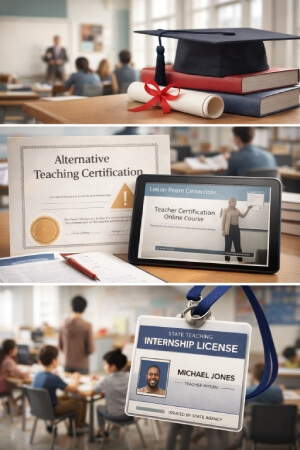
Traditional Teacher Preparation Programs
Traditional programs are typically offered through colleges and universities. Candidates complete a structured course of study that combines education theory, subject-area coursework, and supervised student teaching. These programs are often completed as part of a bachelor’s degree or as a post-baccalaureate certification.
This route is commonly chosen by individuals who decide early that they want to teach. The timeline is predictable, and student teaching placements are integrated into the program before a full-time teaching role begins.
Alternative Certification Routes
Alternative routes are designed for candidates who already hold a bachelor’s degree, often in a non-education field. These programs allow individuals to begin teaching while completing required coursework and assessments. The structure is usually more compressed than traditional programs.
Alternative certification is frequently used to address teacher shortages in specific subjects or regions. While the classroom responsibility starts earlier, candidates still work under defined supervision and must meet the same state standards to earn full licensure.
Teacher Internship Models
Internship models place candidates in classrooms as teachers of record while they complete credentialing requirements. Unlike short-term student teaching, internships may last a full academic year or longer. Interns are typically supported by mentors and university or district supervisors.
This pathway blends employment and preparation. It is often used by career changers who want immediate classroom experience, while still progressing toward a standard teaching credential.
State-Specific Variations and Licensing Exams
Although these categories are common nationwide, each state defines its own rules. States may require specific exams, background checks, or additional coursework. Some issue provisional or preliminary licenses before granting full certification.
Understanding state requirements is essential for anyone planning a teaching career, especially if they intend to move between states during their career.
Educational Roles Within Teaching Careers
Teaching careers extend beyond the traditional image of a single classroom teacher. Schools rely on a range of specialized roles that support student learning in different ways. These roles often require additional credentials or experience but remain part of the broader teaching profession.

Classroom Teachers
Classroom teachers are responsible for delivering instruction to a defined group of students, usually within a specific grade level or subject. Their work includes lesson planning, assessment, classroom management, and communication with families.
This role forms the foundation of most teaching careers. Experience as a classroom teacher is often required before moving into more specialized or leadership-focused instructional roles.
Specialist Teachers
Specialist teachers focus on particular subjects or student needs. Examples include special education teachers, English language development teachers, reading specialists, and STEM-focused instructors. Their schedules may involve working with smaller groups or supporting multiple classrooms.
Specialists typically complete additional training related to their focus area. Their role complements classroom instruction by addressing targeted learning goals or providing specialized support.
Instructional Coaches
Instructional coaches work primarily with other teachers rather than directly with students. They observe classrooms, provide feedback, and support curriculum implementation and teaching strategies. Their goal is to improve instructional quality across a school or district.
This role often requires several years of classroom experience. Instructional coaches act as a bridge between school leadership and classroom practice, focusing on professional development rather than evaluation.
Support and Hybrid Instructional Roles
Some teaching careers combine instructional duties with coordination or advisory responsibilities. These may include curriculum coordinators, intervention teachers, or mentoring roles for new educators. Time is often split between teaching and collaboration.
These hybrid roles reflect how teaching careers can evolve over time, allowing educators to stay connected to instruction while expanding their influence within a school system.
Common Features Across Teaching Careers
While roles and credentials vary, teaching careers share several common characteristics. These elements define professional expectations across schools and states.
- Ongoing professional development requirements
- Regular evaluation tied to instructional practice
- Collaboration with colleagues and families
- Ethical and legal responsibilities related to student welfare
Together, these features highlight that teaching is a regulated profession with shared standards, regardless of role or credentialing route.
Understanding the Structure of Teaching Careers
Teaching careers in the United States are a combination of some state-issued certifications and various instructional roles. Aspiring educators may begin this trade through traditional programs, alternate routes, or internship models, which each incorporate some mix of coursework, experiences, and assessments.
Oklahoma is the first state requiring an "America First" certification test for teachers moving from blue states like California and New York. They must pass exams on U.S. history, civics, the Constitution, and basic biology to align with values of truth and responsibility.… pic.twitter.com/WAiCWF8WIZ
— (@TheThe1776) August 4, 2025
Breaking: Mississippi has now surpassed Texas, California, and New York in cumulative state education rankings according to the National Assessment of Educational Progress (a congressional mandated program also known as the nation’s report card). A HUGE thank you to all of our… pic.twitter.com/YSz0kx05xb
— Robert St. John (@robertstjohn) May 12, 2025